The Muscle Part Between the Front Legs of a Beef Animal Is the
During butchering, beef is beginning divided into primal cuts, pieces of meat initially separated from the carcass. These are bones sections from which steaks and other subdivisions are cutting. The term "cardinal cut" is quite unlike from "prime number cut", used to characterize cuts considered to be of higher quality. Since the beast's legs and cervix muscles practice the almost piece of work, they are the toughest; the meat becomes more tender equally altitude from hoof and horn increases. Different countries and cuisines have dissimilar cuts and names, and sometimes use the same name for a different cut; e.g., the cutting described equally "brisket" in the US is from a significantly dissimilar part of the carcass than British "brisket". "Cutting" often refers narrowly to skeletal musculus (sometimes attached to bones), but can likewise include other edible flesh, such as offal (organ meat) or bones without significant muscles attached.
American cuts [edit]

The post-obit is a list of the American primal cuts, and cuts derived from them. Beef carcasses are split along the axis of symmetry into "halves", then beyond into front and dorsum "quarters" (forequarters and hindquarters). Canada uses identical cut names (and numbering) every bit the U.S, with the exception of the "round" which is called the "hip".[1]
Forequarter cuts [edit]
- The chuck is the source of os-in chuck steaks and roasts (arm or bract), and boneless clod steaks and roasts, nearly unremarkably. The trimmings and some whole boneless chucks are footing for ground beef.
- The rib contains part of the curt ribs, the prime rib and rib heart steaks.[ii]
- Brisket, primarily used for barbecue, corned beefiness or pastrami.
- The foreshank or shank is used primarily for stews and soups; it is not usually served any other way because it is the toughest of the cuts.
- The plate is the other source of curt ribs, used for pot roasting, and the outside brim steak, which is used for fajitas. The omphalus is the ventral part of the plate, and is commonly used to brand pastrami. The remainder is usually ground, every bit it is typically a tough and fat meat.
Hindquarter cuts [edit]
- The loin has two subprimals
- the short loin, from which the T-os and porterhouse steaks are cutting if os-in, or strip steak.
- the sirloin, which is less tender than short loin, but more than flavorful, can exist farther divided into top sirloin and lesser sirloin (including tri-tip), and
- the tenderloin, which is the most tender, can be removed every bit a split subprimal, and cutting into filet mignons, tournedos or tenderloin steaks, and roasts (such equally for beef Wellington). They tin too be cut os-in to make parts of the T-bone and porterhouse loin steaks.
- The round contains lean, moderately tough, lower fat (less marbling) cuts, which crave moist or rare cooking. Some representative cuts are round steak, eye of round, peak round, and lesser round steaks and roasts.
- The flank is used generally for grinding, except for the long and flat flank steak, best known for utilise in London broil, and the inside brim steak, also used for fajitas. Flank steaks were once 1 of the well-nigh affordable steaks, because they are essentially tougher than the more desirable loin and rib steaks. Many modern recipes for flank steak employ marinades or moist cooking methods, such every bit braising, to improve the tenderness and flavour. This, combined with a new interest in these cuts' natural leanness, has increased the cost of the flank steak.[ citation needed ]
Argentine cuts [edit]
The most important cuts of beefiness in the Argentine cuisine are:[3]
- Asado
- the large section of the rib cage including short ribs and spare ribs
- Asado de tira
- often translated as short ribs, merely also sold as long, thin strips of ribs. Chuck ribs, flanken fashion (cross-cut).
- Bife de costilla
- T-os or porterhouse steaks
- Bife de chorizo
- strip steak, chosen NY strip in United states
- Ojo de bife
- ribeye steak
- Bola de lomo
- eye of the round
- Chinchulín
- upper portion of small intestines
- Colita de cuadril
- tri-tip, or the tail of the rump roast
- Cuadril
- rump
- Entraña
- skirt steak
- Falda
- omphalos
- Lomo
- tenderloin
- Matambre
- a long thin cutting that lies merely under the skin and runs from the lower part of the ribs to abdomen–or flank area
- Mollejas
- sweetbreads (thymus gland)
- Pecho
- brisket
- Riñones
- kidneys
- Tapa de asado
- rib cap
- Tapa de nalga
- acme of round roast
- Vacío
- flank, though it may contain the muscles of other about cuts
Brazilian cuts [edit]
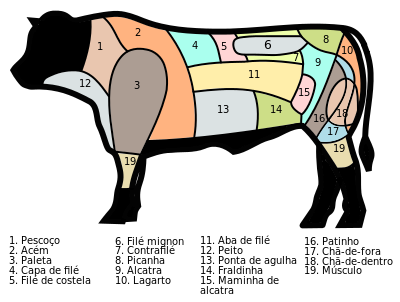
The most important cuts of beef in the Brazilian cuisine are:[4]
- Acém
- neck (ii)
- Alcatra
- elevation/bottom sirloin (nine)
- Contrafilé
- tenderloin (vii)
- Coxão duro
- circular (upper)
- Coxão mole
- round (lower)
- Filé Mignon
- part of the tenderloin (vi)
- Lagarto
- circular (outer) (x)
- Maminha
- bottom sirloin/flank (fifteen)
- Patinho
- confluence of flank, bottom sirloin and rear shank (16)
- Picanha
- rump cover or rump cap
- Cupim
- hump (zebu cattle only)
- Fraldinha
- confluence of brusk loin, flank and bottom sirloin
- Paleta
- chuck/brisket (iii)
British cuts (as well used in New Zealand) [edit]

- Tongue
- Necks and clod
- Chuck steak & blades
- Sirloin
- Rump
- Silverside
- Topside
- Meridian rump
- Fore rib
- Rib eye steak
- T-bone steak
- Thick rib
- Sparse rib
- Brisket (Skirt steak)
- Shin and leg
- Flank
- Thick flank
- Plumage blade
- Fillet
- Oxtail
Colombian cuts [edit]
- Posta (top round)
- Muchacho (heel)
- Huevo de Aldana (lesser round)
- Entretabla
- Tabla (lesser round)
- Solomo or lomo
- Solomito extranjero
- Solomito Redondo (sirloin)
- Solomito Largo (tri-tip)
- Punta de Anca (sirloin tip heart)
Dutch cuts [edit]

- Neck
- Rib steak
- Sirloin
- Tenderloin – Considered to exist the premium cut, highly prized. It is called 'ossenhaas' in Dutch. It tends to be cutting slightly smaller than its American counterpart.
- Top sirloin
- Circular – Mainly used for kogelbiefstuk ('hip joint steak') considered to be the bones grade of steak in Dutch and Belgian cuisine.
- Flank
- Chuck – Best cuts are used for stoofvlees, lesser bits are used in hachee.
- Brisket
- Shankle
- Beef tongue is considered the cheapest slice of beef; it is used in certain styles of sausages such as the frikandel, though not as the main ingredient.
- Oxtail, though not on the paradigm shown, is used extensively in stews.
French cuts [edit]

Brighter colors show more expensive cuts
$$$ indicates more expensive cuts; $ indicates less expensive cuts; $$ indicates in betwixt.
- Basses côtes $$$
- Côtes, entrecôtes $$$
- Faux-filet $$$
- Filet $$$
- Rumsteck $$$
- Rond de gîte $$$
- Tende de tranche; poire, merlan $$$
- Gîte à la noix $$$
- Araignée $$$
- Plat de tranche, rond de tranche, mouvant $$$
- Bavette d'aloyau $$$
- Hampe $$$
- Onglet $$$
- Aiguillette baronne $$$
- Bavette de flanchet $$
- Plat de côtes $$
- Macreuse à bifteck $$
- Paleron $$
- Jumeau à bifteck $$
- Jumeau à pot-au-feu $$
- Macreuse à pot-au-feu $$
- Queue $
- Gîte $
- Flanchet $
- Tendron, milieu de poitrine $
- Gros tour de poitrine $
- Collier $
- Joue $
- Langue $
German cuts [edit]

- Rinderhals, Kamm or Nacken (Chuck steak)
- Querrippe (Brusk ribs)
- Rinderbrust (Brisket)
- Hochrippe or Fehlrippe (Standing rib roast)
- Vorderrippe or hohes Roastbeef
- Rostbraten or flaches Roastbeef
5. & vi. together are the Roastbeef or Zwischenrippenstück - Filet (Fillet)
- Spannrippe or Knochendünnung
- Dünnung or Bauchlappen (flank steak)
- Falsches Filet, Schulter, Issues or Schaufel (shoulder)
- Oberschale, Unterschale and Nuss
- Flanke, Schliem or Rindfleisch
- Hüfte mit Hüftsteak and Schwanzstück or Tafelspitz (Meridian sirloin))
- Hesse or Wade (Beef shank)
- Fricandeau
- Schwanz or Ochsenschwanz (Oxtail)
Croatian cuts [edit]

- Vratina
- Hrskavi zapećak
- Rebra
- Pržolica (ramstek)
- Hrbat (rozbif)
- Hrbat (rozbif)
- Pisana pečenka (biftek)
- Rebra, mekana (srednja) rebra, potrbušina
- Masna potrbušina, slabina
- Rame (ribica), plećka (lopatica)
- Merely
- Vrh kuka
- Zdjelica
- Stražnja goljenica
Italian cuts [edit]

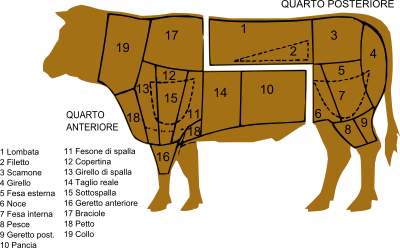
- Leg subcuts[v]
- Codone
- Scanello, noce or fesa (bottom sirloin or thick flank)
- Sottofesa or fetta di mezzo or codino or controfesa or contronoce
- Fianchetto (flank)
- Rosa, fesa interna, punta d'anca (eye of the silverside)
- Magatello or girello
- Spinacino or tasca
- Sirloin (lombata) subcuts[5]
- Filetto (beef tenderloin)
- Controfiletto or roast beef (sirloin)
- Veal Carré (spare ribs)
- Costolette
- Nodini
- Loin (schiena)[5]
- Costata (T-os steak)
- Coste della croce (short ribs)
- Neck[5]
- Collo (Chuck steak)
- Reale or tenerone
- Head subcuts[5]
- Lingua (Beef tongue)
- Testina (flesh from the head of a dogie)
- Shoulder subcuts[5]
- Fesone di spalla
- Fusello or girello di spalla
- Brione
- Cappello del prete or spalla
- Hocks subcuts[5]
- anterior and posterior Ossibuchi
- Pesce, piccione, campanello, muscolo, gamba
- Petto (chest) subcuts[5]
- Punta di petto (Brisket)
- Pancia di vitello, pancetta or fianchetto
- Lower ribs subcuts[5]
- Biancostato di reale or spuntatura
- Taglio reale, polpa reale (Pony 6 Ribs, Square Cut, Chuck, Middle Rib, Steak Meat)
- Pancia (belly) subcuts[5]
- Biancostato di pancia
- Fiocco
- Scalfo (armhole)
Polish cuts [edit]
- karkówka
- szponder
- mostek
- rozbratel
- antrykot
- rostbef
- polędwica
- szponder i mostek
- łata
- łopatka
- udziec (zrazowa górna i zrazowa dolna)
- skrzydło
- krzyżowa
- pręga
- ligawa
- ogon
Portuguese cuts [edit]

- Cachaço
- Coberta do acém, acém comprido
- Pá, peito alto
- Maçã do peito
- Peito
- Chambão
- Mão
- Lombo
- Rosbife, acém redondo, vazia, entrecôte
- Prego practice peito
- Aba grossa
- Alcatra
- Chã de fora
- Rabadilha
- Pojadouro
Russian cuts [edit]

- Шея/Sheya (cervix)
- Рёбра/rjobra (ribs)
- Челышко/Chelyshko, грудинка/grudinka (brisket)
- Толстый край/Tolstyy kray (thick edge), рибай/ribay (rib eye), корейка на кости/koreyka na kosti (loin on the bone)
- Тонкий край/Tonkiy kray (thin edge), короткое филе/korotkoye file (short filet)
- Оковалок/Okovalok (sirloin)
- Вырезка/Vyrezka (tenderloin)
- Покромка/Pokromka (shortloin)
- Брюшина/Bryushina (peritoneum), фланк/flank
- Лопатка/Lopatka (shoulder)
- Oguzok (rump), bedro (hip)
- Пашина/Pashina (flank)
- Кострец/Kostrets (leg)
- Голяшка/Golyashka (shank)

ГОВЯДО ср. церк. крупная рогатая скотина, бык, вол или корова. Говяжий, от быка, говяда взятый, из мяса его приспетый. Говядина ж. говяжье мясо. Части говядины, у мясников, называются: 1) голова, two) шея, зарез, 3) оковалок, 4) челышко, 5) толстый край, 6) средина лопатки, 7) тонкая лопатка, рулька, 8) тонкий край, 9) от края покромка, 10) грудина, 11) тонкий филей, 12) подпашек, thirteen) завиток, 14) толстый филей, xv) бочок, 16) английский филей, 17) огузок, 18) средина бедра, 19) кострец, xx) ссек, подбедерок; окосток, часть ссека, с вертлюжной костью, 21) голяшка. Зачисток, от краев, от шеи, тонкие остатки, оборыши. Голяшки и морда, студень. Легкие, сердце и печень, гусак, ливер, осердье. Желудок с кишками, требуха, требушина. У мясников иностранных говядина делится иначе. Были бы быки, а говядина будет. По барыне говядина, по харчевне едок. Говядарь гуртовщик, прогонщик, нагульщик скота и скотопромышленик.
Turkish cuts [edit]

- Gerdan
- neck,chuck (1)
- Antrikot
- rib steak, ribeye(2)
- Kontrfile
- Steak, striploin(3)
- Sokum
- rump (4)
- Bonfile
- fillet Steak,tenderloin(five)
- Tranç
- the upper left side of nuar, inside round, height circular(6)
- Nuar
- circular of beef, eye of circular (vii)
- Kontrnuar
- the lower left side of nuar, flat, gooseneck(with middle of circular), (8)
- incik
- forepart and rear leg (nine, 14)
- Yumurta
- sirloin tip, the section between kontrnuar and pençata (ten)
- Pençata
- flank (xi)
- Döş
- brisket, plate, short ribs(12)
- Kürek, kol
- shoulder, shank (13)
UNECE standard for bovine meat carcasses and cuts [edit]
| | This department is missing information about cut prototype. (October 2020) |

The UNECE standard formalizes internationally agreed upon specifications written in a consistent, detailed and accurate manner using anatomical names to identify cutting lines.[6]
See also [edit]
- List of steak dishes
- Meat on the bone
- Steak
References [edit]
- ^ "Beef Cuts by Chart". Clovegarden.com. Retrieved 18 December 2011.
- ^ "What's the Difference Between Beef Back Ribs and Short Ribs?". LIVESTRONG.COM . Retrieved 2022-05-25 .
- ^ Instituto de Promoción de la Carne Vacuna Argentina. "Principales Cortes Vacunos". Retrieved Apr 17, 2017.
- ^ "Cuts of Beef Served in Brazilian Steakhouses « « RodizioDirectory.Com RodizioDirectory.Com". Archived from the original on 2013-01-03. Retrieved 2013-05-08 .
- ^ a b c d due east f 1000 h i j Scheda sui tagli di carne bovina Archived 2011-04-23 at the Wayback Machine di Alimentipedia.it
- ^ Un. Economical Commission for Europe (2004). Bovine meat : carcases and cuts : UNECE standard (PDF). United Nations. Economic Committee for Europe. Working Party on Agricultural Quality Standards (Ed. 2004 ed.). New York: Un. ISBN92-1-116885-half dozen. OCLC 56597200.
External links [edit]
- Agence canadienne d'inspection des aliments - Boeuf - Manuel de coupes de viande
- French-German butcher glossary
malpasshavenalwas.blogspot.com
Source: https://en.wikipedia.org/wiki/Cut_of_beef

Enregistrer un commentaire for "The Muscle Part Between the Front Legs of a Beef Animal Is the"